
Italian
Recorded in Milan, Naples, Rome and the diaspora, 1890s–1940s
These sides gather Italian opera and song across the years 1901 to 1924. Almost all fall safely before 1923; a single side—the 1924 Traviata duet—sits in the later gray band. Enrico Caruso, the Neapolitan tenor whose own sides here run from 1901 to 1921, stands at the center of the set.
Verdi returns again and again: Caruso in ‘La donna è mobile’ and the romanza from Un ballo in maschera, the Miserere from Il trovatore with Frances Alda and the Metropolitan Opera Chorus, and the 1924 ‘Un dì felice’ with Amelita Galli-Curci and Tito Schipa. Mascagni’s Siciliana from Cavalleria rusticana appears more than once; Flotow’s Martha is heard in ensemble with Alda, Jacoby, Caruso and Marcel Journet; Gounod’s Faust prison scene brings Farrar, Caruso and Journet together.
Around them stand Titta Ruffo in Leoncavallo’s Zazà and a Mozart serenade, Giovanni Martinelli in Donizetti’s Don Pasquale, Beniamino Gigli in Lalo’s Le Roi d’Ys, Antonio Scotti in Bizet and Mozart, and Pasquale Amato in Mascagni and Ponchielli. Song and lighter pieces keep company with the arias—Nutile’s ‘Mamma mia che vo’ sapè,’ Tosti settings, a tarantella, Rotoli’s ‘Mia sposa sarà la mia bandiera,’ and a 1919 serenata carrying Caruso’s own lyric.
About this hearth
Milan, Naples and other Italian cities hosted major label activity from the earliest years of the industry; Italian singers also recorded constantly abroad. Operatic arias and ensembles share the catalogues with guitar- and mandolin-led southern song, accordion dance music and dialect traditions from many regions. The bel canto vocal ideal colours even popular sides, while street and festival repertories keep a rougher edge. These records trace both a national art-music export and the local voices of peninsula and diaspora life.
Recorded in: Milan, Naples, Rome, New York
Naples, in their time
Naples in the street — flower sellers, cobblers working at the kerb, and the crowd that turned out for Theodore Roosevelt in 1909. Library of Congress and Google Cultural Institute.
Press any photograph to open it full size — the player keeps going behind it.
The music-makers and the dress
10 period photographs of this hearth's own music-makers and dress, every one dated from its source's own records. Pictures are shown as documentary record, credited to the holding collection; anything here is removed on request. Sources: Wikimedia Commons (10).
Press any photograph to open it full size — the player keeps going behind it.
Figures on record
Every card is a genuine photograph of the artist, credited to its source. Performers of this era often left no portrait behind — where none survives, we show nothing rather than a stand-in image. Pick a figure to pull their recordings up.
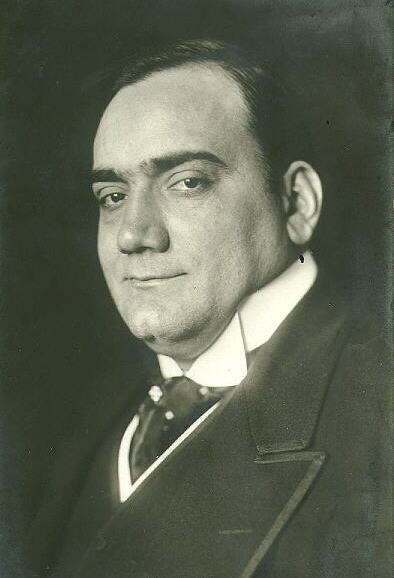
Italian operatic tenor whose records made him the most famous voice of the era. The Italian hearth holds his sides from 1901 to 1921, from La donna è mobile to the Faust prison scene.
Postcard, ca. 1910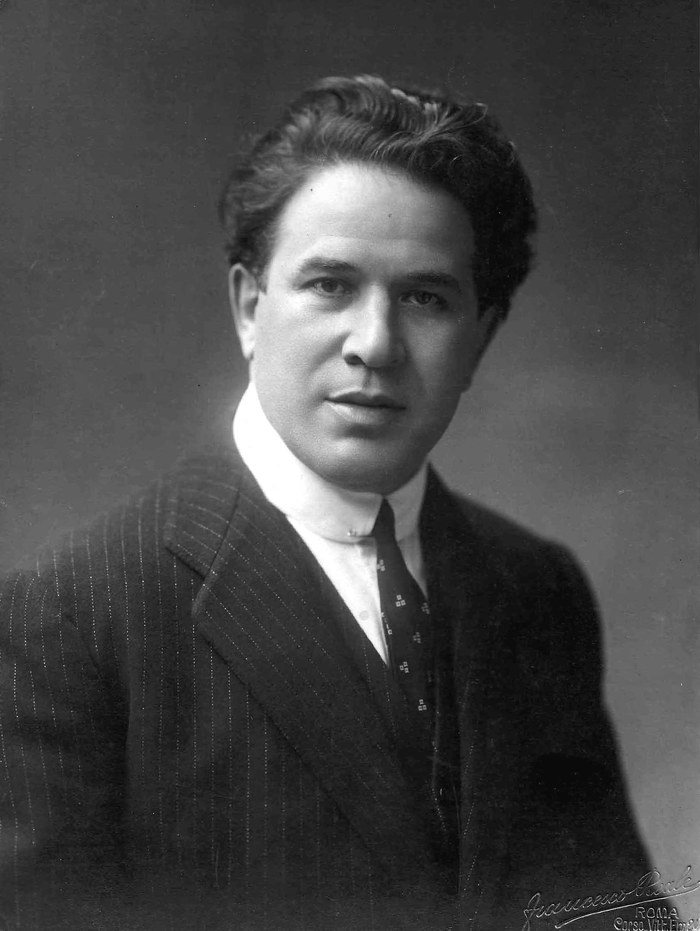
Italian baritone known as the Lion of Pisa, among the most recorded voices of the acoustic era. He sang Leoncavallo and Mozart on the sides held here.
Studio portrait, 1920sRestored Recordings
Every track below is a remaster. Press play on the full sequence, or pick a single recording.
"Ma se m' è forza perderti" (Forever to Lose Thee!)
(1) Don Giovanni–Serenata, "Deh vieni alla finestra" (Open Thy Window, Love); (2) Falstaff-Quand' ero paggio (When I Was Page)
Andrea Chénier-Come un bel dì di maggio (As Some Soft Day in May)
Aprilatuafinestra! (Serenata)
Ballo in Maschera - Barcarola - Di tu se fedele (Masked Ball - The Waves Will Bear Me)
Ballo in Maschera-Ma se m' è forza perderti-Romanza (Masked Ball-Forever to Lose Thee!)
Canzonetta
Cavalleria Rusticana - Siciliana (Thy Lips Like Crimson Perries)
Cavalleria Rusticana (SICILIANA)
Cavalleria Rusticana–Canzone Alfio (Alfio's Song)
Che vuol dir Cìo (Surprised and Astounded!)
Chevuoldirciò
Don Giovanni-Serenata, "Deh vicni alla finestra" (Open Thy Window) (Act II)
Don Pasquale - Serenata "Com' è gentil" (Soft Beams the Light) (Act 3)
Faust - "Prison Scene," Part 3 - Alerte! Où vous êstes perdus (Then Leave Her!) (Act 5)
Forosetta Tarantella
Gioconda - Barcarola, "Pescator affonda l'esca" (Fisher Boy, Thy Bait Throw) (Act II, Scene I)
Iomorrò, malietoincore
La donna è mobile (Woman is Fickle)
La Mia Canzone
Ladonnaèmobile
Lafleurquetum' avaisjetée
Lamiacanzone
Le Cid - O souverain, o juge, o père! (Almighty Lord, Oh Judge, Oh Father!)
Le Régiment de Sambre et Meuse (The Regiment of Sambre and Meuse)
Le Roi d'Ys - Vainement, ma bien aimée (The King of Ys - In Vain, My Beloved)
Mamma mia che vo' sapè?
Martha-Che vuol dir Cìo (Surprised and Astounded)
Mia sposa sarà la mia bandiera (My Bride Shall be My Flag)
Moncoeurestpénétréd' épouvante
Moncoeurs' ouvreàtavoix
O souverain, o juge, o père! (Almighty Lord, Oh Judge, Oh Father!)
OLola! (Siciliana)
Pagliacci - Serenata D'Arlecchino (Harlequin's Serenade)
Pietà Signore (Lord, Have Mercy)
Pourquoimeréveiller?
Prèsdesrempartsde Séville
Qualvoluttàtrascorrere
Rigoletto–La donna è mobile (Woman is Fickle)
Sèrènade Espagnole (Spanish Serenade)
Serenata
Suonno 'e fantasia (Dream and Fantasy) (La Canzonetta)
Tarantella Sincera
Traviata-Un dì felice (Rapturous Moment)
Trovatore-Miserère
Votretoast (Chansondu Toréador)
Zaza-Buona Zazà, del mio buon tempo (Act II)
About the restoration
Every recording here is a historical track sourced from a public archive and remastered through a purpose-built chain — the same fixed chain for every file, no machine-learning enhancement. The aim is simple: sound better, and meet YouTube's audio standards. Rights status differs per recording and sources are credited where known; anything still in copyright is published with attribution and removed on request. The surface noise of the original transfer is still audible, because removing it completely would mean removing the recording too. How the restoration works →