
Lithuanian
Recorded in Lithuania and in North American communities, 1900s–1930s
These sides gather Lithuanian orchestra music as it reached emigrant listeners under names such as the Lithuanian Folk Orchestra of Boston and the Baltimore Lithuanian Radio Orchestra. Seven sides carry the Boston credit, five of them with Ona Ivaska; four come from the Baltimore group, variously with Don Gabor and with Clemenasas Andreikus or Clemensas Anreikus. Single sides add Jouzas Suildauskas, Brunon Kryger “King of the Polkas” and his International Dance Orchestra, the Folkraft International Orchestra under Frank L. Kaltman, Mahanojaus Lietuviska Maineriu Orkestra, and A. Jezavito Radio Orkiestra with G. Wally and P. D. Vich.
The repertoire stays close to the dance floor. Boston offers the 1950 pairing “OŽELIS (Billy Goat)” and “MIKITA (Stick Dance),” together with “USTAS,” “Kubilas (The Tub),” “Suktinis (The Twirlers),” “SUSTAS,” “RUGUČIAI,” and “MALŪNAS (The Mill).” Baltimore supplies “Lithuanian Girls’ Waltz - Lietuvos Mergaiciu,” “Vilna Polka - Vilniaus Polka,” “The Gay Bachelor - Bernuzeli Nes Voliok,” and “Do You Know? Ar Tu Zinai.” Elsewhere stand Suildauskas’s 1925 “Skamba kanklės ir trimitai,” Kryger’s “LITHUANIAN POLKA (Wedding Polka),” the miners’ “Lithuanian Wedding,” Folkraft’s “DZUKU (Lithuanian),” and Jezavito’s “Lietuviska Polka - Lithuanian Polka.”
Only two years are printed on the sides themselves—1925 and 1950. Most remain in the unknown rights class, a few sit in the 1947+ risky band, and a single side falls in the 1923–46 gray range. The word “orchestra” or “orch” appears on thirteen titles; “polka” on three, with a single waltz and a single dance.
About this hearth
Domestic recording was modest; Lithuanian-American singers and ensembles produced a substantial share of the pre-war disc legacy for immigrant audiences. Sutartinės and other older multipart practices surface more clearly in ethnographic collecting than in mass-market catalogues, which favour arranged folk song, choir music and dance bands. Birbynė, kanklės and fiddle colours appear in traditional contexts. The records document language and melody sustained both in the homeland and far from it.
Recorded in: Vilnius, Kaunas, Chicago, New York
Kaunas, in their time
Kaunas, the provisional capital between the wars — the station yard with its trams and carts, the shops, and the crowds outside the Constituent Assembly. Wikimedia Commons and the Lithuanian archives.
Press any photograph to open it full size — the player keeps going behind it.
The music-makers and the dress
8 period photographs of this hearth's own music-makers and dress, every one dated from its source's own records. Pictures are shown as documentary record, credited to the holding collection; anything here is removed on request. Sources: Wikimedia Commons (8).
Press any photograph to open it full size — the player keeps going behind it.
Figures on record
Every card is a genuine photograph of the artist, credited to its source. Performers of this era often left no portrait behind — where none survives, we show nothing rather than a stand-in image. Pick a figure to pull their recordings up.
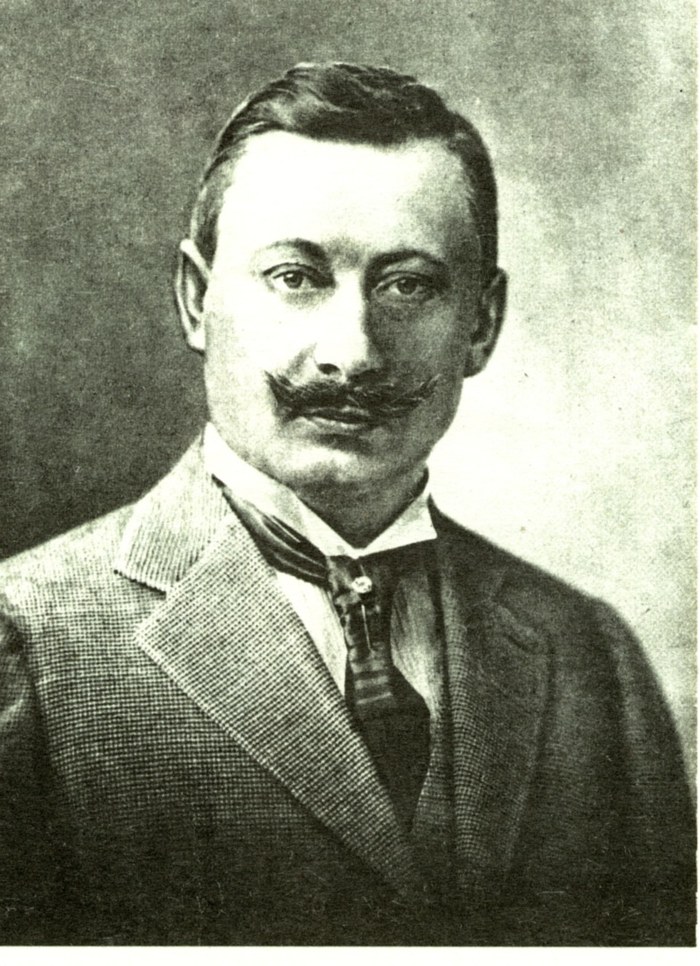
Composer of the first Lithuanian national opera — and of 'Skamba kankliai ir trimitai', the folk love song on this hearth's Edison side.
Lietuvos albumas, Kaunas / Berlin, 1921 — public domainRestored Recordings
Every track below is a remaster. Press play on the full sequence, or pick a single recording.
1. OŽELIS (Billy Goat); 2. MIKITA (Stick Dance)
Do You Know? Ar Tu Zinai
DZUKU (Lithuanian)
Kubilas (The Tub)
Lietuviska Polka - Lithuanian Polka
Lithuanian Girls' Waltz - Lietuvos Mergaiciu
LITHUANIAN POLKA (Wedding Polka)
Mahanoy City Lithuanian Miners Orchestra - Lithuanian Wedding
MALŪNAS (The Mill)
RUGUČIAI
Skamba kankliah ir trimintai - Lithuanian folk love song
Suktinis (The Twirlers)
SUSTAS
ŠUSTAS
The Gay Bachelor - Bernuzeli Nes Voliok
Vilna Polka - Vilniaus Polka
About the restoration
Every recording here is a historical track sourced from a public archive and remastered through a purpose-built chain — the same fixed chain for every file, no machine-learning enhancement. The aim is simple: sound better, and meet YouTube's audio standards. Rights status differs per recording and sources are credited where known; anything still in copyright is published with attribution and removed on request. The surface noise of the original transfer is still audible, because removing it completely would mean removing the recording too. How the restoration works →